Anatomy of a Flagship: Versace Home’s Dubai Showroom as Architectural Case Study
The Versace Home flagship showroom in Dubai represents a convergence of Italian craftsmanship and spatial strategy that extends beyond conventional luxury retail design. Solomia Home, the region’s official dealer of Italian furniture, commissioned this space to serve as both a commercial environment and a three-dimensional manifesto of brand architecture. Located within Dubai’s competitive design landscape, the showroom spans 420 square meters across two levels and uses Pure Black marble as its primary material vocabulary. The project emerged from a 14-month development cycle that began with site analysis in March 2023 and concluded with installation completion in May 2024.
Solomia Home operates as an award-winning design studio in Dubai, having received the International Property Award for Interior Design in 2023 and maintaining a portfolio that spans residential, commercial, and hospitality sectors across the Middle East. The studio’s approach to the Versace Home commission centered on translating the brand’s visual DNA into physical space without defaulting to decorative excess. Rather than treating the Medusa motif as applied ornament, the design team integrated it as structural articulation through CNC-milled panels and bas-relief work that modulates surface depth across wall planes and ceiling coffers.
Material Hierarchy and Stone Selection
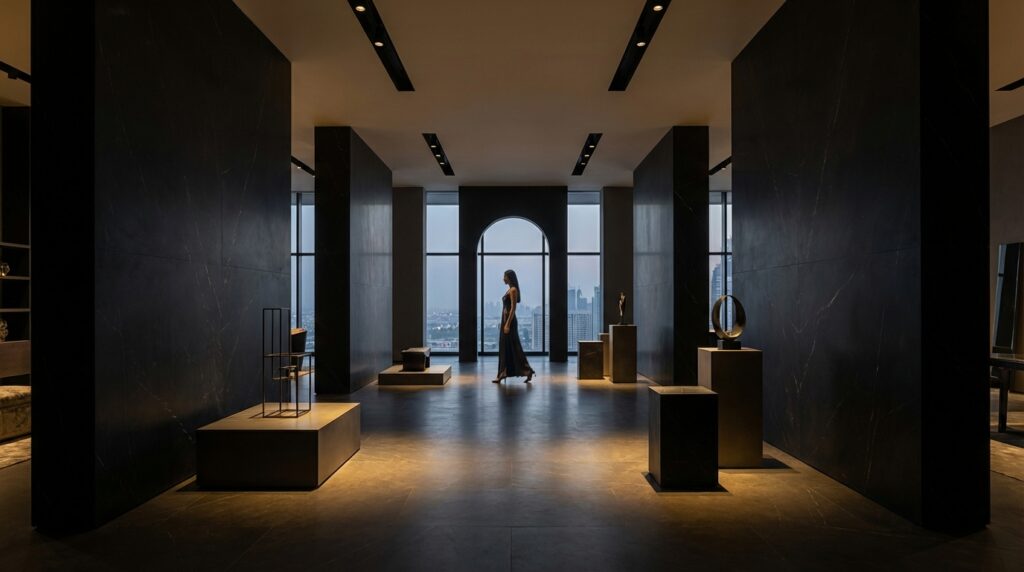
Pure Black marble from the Marquina quarries in Spain forms the spatial envelope, selected for its uniform chromatic field and capacity to register light modulation. The stone arrives in 3-centimeter-thick slabs, book-matched across vertical surfaces to maintain vein continuity. Unlike typical commercial applications where marble serves as an accent material, the showroom deploys it as a continuous skin that wraps floor, wall, and ceiling transitions. This creates a monolithic reading that absorbs ambient light during daylight hours and reflects directed illumination after sunset, fundamentally altering the spatial character across operational cycles.
The material specification extends to technical considerations that impact long-term performance. All marble surfaces receive a honed finish rather than high polish, reducing glare while maintaining depth of color. Joints between slabs measure 2 millimeters and are filled with black epoxy, rendering seams nearly invisible under showroom lighting. The installation team employed a rear-ventilation cavity system, enabling moisture management in Dubai’s climate while preventing efflorescence, which typically compromises dark stone installations in humid environments.
Medusa Motif as Structural Element
The Medusa ’95 collection served as the geometric source material for a series of milled relief panels distributed across the showroom’s vertical surfaces. Rather than reproducing the logo at a consistent scale, the design deploys it across three distinct dimensions: 80-centimeter-diameter panels for primary focal walls, 40-centimeter panels for transitional zones, and 20-centimeter panels for detail areas. This scalar variation prevents visual monotony while establishing a rhythmic pattern that guides movement through the space.
Fabrication was performed using five-axis CNC milling, translating vector artwork into toolpaths that produce relief depths ranging from 8 millimeters in background areas to 35 millimeters at figure peaks. The milling process requires 14 hours per panel for the largest diameter versions, with tolerances held to 0.1 millimeters to ensure crisp edge definition where light rakes across surface transitions. Each panel undergoes hand-finishing to remove tool marks while preserving the intentional texture that differentiates CNC work from traditional stone carving.

The Medusa panels serve both structural and decorative purposes, concealing acoustic absorption material that manages reverberation time in hard-surfaced environments. Behind each relief panel sits a 50-millimeter cavity filled with compressed mineral wool, reducing mid-frequency reverberation by approximately 40 percent according to post-occupancy acoustic testing. This dual functionality exemplifies the project’s resistance to purely decorative solutions, instead layering technical performance within aesthetic systems.
Asymmetric Planning and Circulation
The showroom plan abandons bilateral symmetry in favor of an asymmetric arrangement that responds to the site’s trapezoidal geometry and creates deliberate visual tension. The main display floor measures 12.5 meters along its street-facing edge but extends to only 9.8 meters at the rear, with the differential absorbed through angled wall planes rather than orthogonal adjustments. This creates a subtle perspective distortion that makes the space appear deeper than its actual 16 meters when viewed from the entry threshold.
Circulation follows a choreographed sequence that alternates between compression and expansion. The entry vestibule narrows to 2.4 meters, forcing lateral movement before opening into a 6-meter-wide gallery space where larger furniture pieces achieve visual clearance. A secondary compression zone at mid-depth reduces the path to 1.8 meters, creating a threshold condition before the space expands again into the rear demonstration area. These dimensional shifts manipulate perception of distance and scale without requiring corresponding changes in ceiling height, which maintains a constant 3.9 meters throughout the main level.
The asymmetric strategy extends to lighting placement, where track-mounted fixtures follow the angled wall geometry rather than being organized on an orthogonal grid. This produces lighting zones that overlap irregularly, creating illumination gradients that reinforce the spatial progression. Lux levels range from 800 at task areas where clients examine fabric samples to 200 in transitional zones, with the variation calibrated to prevent abrupt transitions that would disrupt the visual flow.
Gianni Versace’s Design Language in Three Dimensions
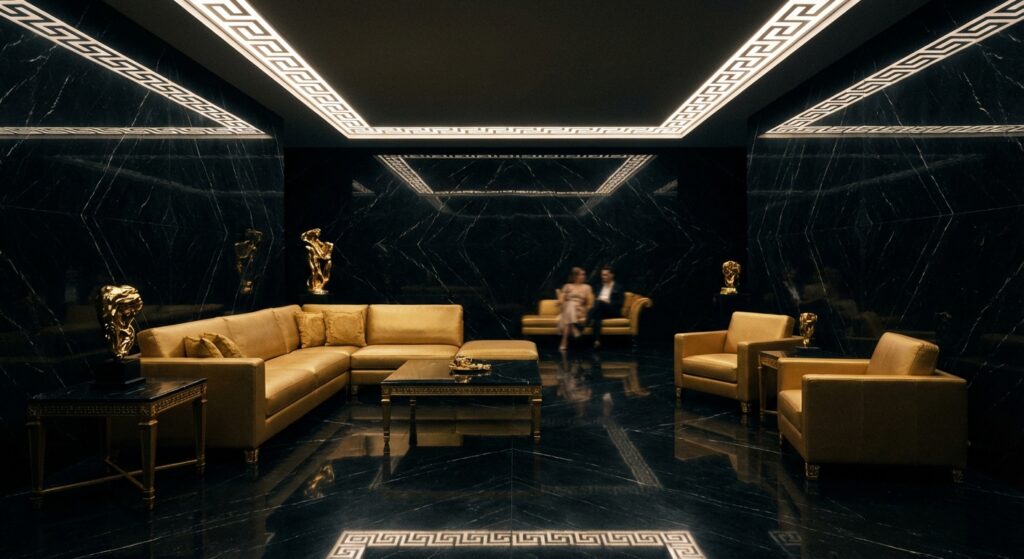
The late Gianni Versace developed a visual system that combined classical references with baroque excess, a tension that the showroom translates into spatial terms through measured application of ornament against minimal backgrounds. Where Versace’s fashion work layered pattern upon pattern, the interior design isolates individual elements within expansive neutral fields, allowing each decorative gesture to register with greater intensity. The Medusa reliefs appear against uninterrupted marble planes, the Greek key patterns that border doorways stand out against flat wall surfaces, and gilded furniture pieces contrast sharply with the chromatic restraint of their architectural context.
This editing process required determining which aspects of the brand vocabulary could translate to architectural scale without becoming overwhelming. The design team conducted full-scale mockups to test pattern density and ornamental concentration, ultimately establishing a ratio in which decorative elements occupy approximately 15 percent of the visible surface area. This constraint prevents the visual cacophony that often characterizes luxury retail environments, instead creating moments of ornamental intensity that punctuate longer passages of material continuity.
Technical Coordination and Installation Sequence
The project’s material complexity demanded precise coordination between stone fabricators in Spain, metalwork shops in Italy, and local installation teams in Dubai. Shop drawings went through seven revision cycles to resolve conflicts between marble panel dimensions and structural constraints, particularly at the ceiling plane, where mechanical systems required integration without disrupting the monolithic surface reading. The solution involved custom-fabricated plenums that distribute conditioned air through linear slots concealed within the Greek key border patterns, maintaining thermal comfort without visible diffusers.
Installation proceeded in reverse from typical construction sequences, beginning with ceiling systems and working downward. This allowed the marble envelope to wrap continuously without horizontal joints that would interrupt the visual field. Wall panels are installed on adjustable brackets that accommodate the building’s measured deflection of 8 millimeters across the 16-meter span, preventing stress cracks that would compromise the stone’s appearance over time. The floor installation was last, with slabs set in a modified thin-set system that allows individual replacement if damage occurs, without disturbing adjacent units.
Performance Metrics and Post-Occupancy Analysis
The completed showroom has operated for eight months as of this writing, generating quantifiable data regarding spatial effectiveness and material performance. A foot traffic analysis indicates that visitors spend an average of 34 minutes in the space, compared to 18 minutes in conventional furniture showrooms of similar size. This extended dwell time correlates with the asymmetric circulation pattern that encourages exploration rather than direct passage from entry to exit.
Material maintenance protocols have verified the suitability of Pure Black marble for commercial applications in Dubai’s climate. Monthly inspections document no visible etching from cleaning agents, no moisture-related staining, and minimal wear patterns despite the space receiving approximately 200 visitors per week. The honed finish proves more resistant to surface scratching than anticipated, maintaining its appearance without the frequent re-polishing required by high-gloss installations.
Thermal performance exceeds initial projections, with the marble mass providing passive cooling that reduces mechanical system loads during operational hours. Temperature sensors embedded at three depths within the wall assembly record a 6 °C differential between the exterior and interior surfaces during peak afternoon hours, demonstrating the stone’s thermal lag capacity. This passive strategy contributes to a 23 percent reduction in cooling energy consumption compared to baseline projections for a similar space with standard wall construction.
The Versace Home showroom demonstrates how brand identity can inform architectural decision-making without reducing space to scenography. Through measured deployment of signature elements, rigorous material specification, and spatial planning that prioritizes experience over efficiency, the project establishes a methodology applicable beyond luxury retail contexts. The integration of decorative and technical systems, the scalar manipulation of familiar motifs, and the strategic use of asymmetry provide a framework for translating two-dimensional graphic languages into three-dimensional environments that perform both commercially and experientially.