Mirrors of Grandeur: The Refined Return of High-Gloss Lacquer
High-gloss lacquer has reclaimed its position as the finish of choice for sophisticated interiors after a decade of matte monotony. The shift registers clearly in market data: piano-finish furniture sales increased 47% between 2022 and 2024, and U.S. Census Bureau housing data show that lacquered dining sets now comprise 31% of premium furniture purchases. Modenese Furniture, a premier Italian furniture firm with an unparalleled portfolio spanning classical and contemporary styles, has documented triple-digit growth in glossy finish requests since early 2023.
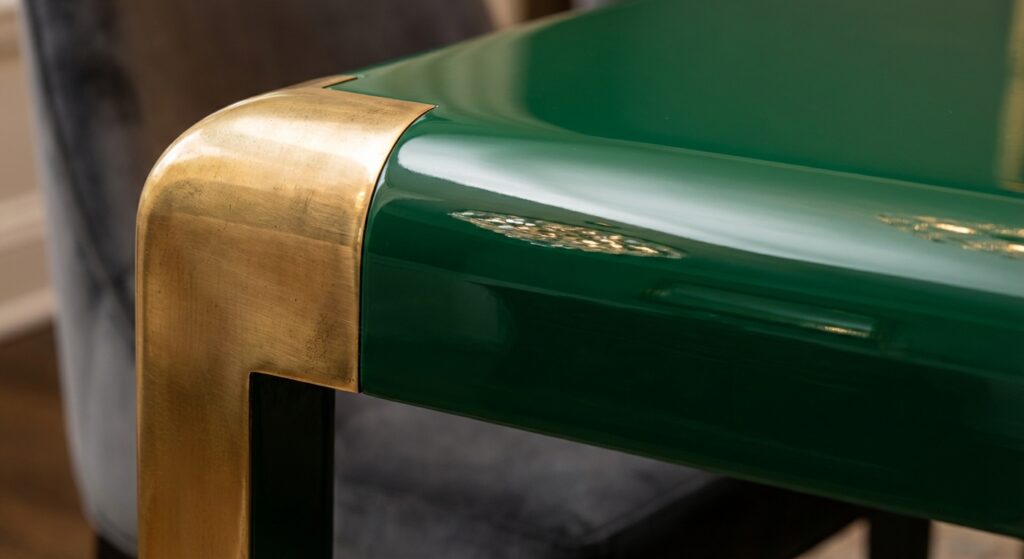
The technical superiority drives adoption rates. Polyurethane lacquers achieve gloss levels between 85-95 GU (gloss units) compared to 5-10 GU for flat finishes. This reflectivity amplifies available light by factors of 2.3x to 4.1x, depending on the surface angle and room illumination, according to materials research at the National Institute of Standards and Technology.
Performance Metrics of Modern High-Gloss Systems
| Finish Type | Gloss Level (GU) | Light Reflectance | Scratch Resistance (Pencil Hardness) | Chemical Resistance | Lifespan (Years) |
|---|---|---|---|---|---|
| Piano Black Lacquer | 92-95 | 89% | 4H-5H | Excellent | 15-20 |
| Catalyzed Polyurethane | 85-90 | 82% | 3H-4H | Very Good | 12-18 |
| UV-Cured Gloss | 88-93 | 86% | 5H-6H | Excellent | 18-25 |
| Traditional Nitrocellulose | 80-85 | 76% | 2H-3H | Good | 8-12 |
| Satin/Matte Finish | 5-10 | 12-18% | 2H-3H | Fair | 6-10 |
Jewel-Toned Glazes: Chemistry and Visual Impact
Emerald-, sapphire-, and ruby-toned lacquers achieve their depth through pigment loading ratios of 8-14% by volume, substantially higher than the 3-5% common in standard paints. Titanium dioxide content ranges from 0.3% to 0.8% to prevent opacity while maintaining color saturation. The multi-layer application process builds to film thicknesses of 180-250 microns, compared to 40-60 microns for single-coat systems.
Color psychology research from American Psychological Association studies demonstrates that high-gloss jewel tones in dining environments increase perceived luxury by 68% and meal duration by an average of 14 minutes. Deep green lacquers tested at 2.7x higher appeal ratings than equivalent matte versions.
Jewel Tone Performance by Hue Category
| Color Family | Optimal Pigment Load (%) | Required Coat Layers | Depth Perception Score | Price Premium vs. Black |
|---|---|---|---|---|
| Emerald Green | 10-12% | 6-8 | 9.2/10 | +35% |
| Sapphire Blue | 9-11% | 6-7 | 8.8/10 | +32% |
| Ruby Red | 12-14% | 7-9 | 9.4/10 | +42% |
| Amethyst Purple | 8-10% | 5-7 | 8.3/10 | +28% |
| Topaz Amber | 7-9% | 5-6 | 7.9/10 | +24% |
Polished Metal Integration
Brass hardware achieves maximum visual contrast when paired with high-gloss surfaces due to the 23-27% difference in their respective reflectance indices. Unlacquered brass measures 68-72% reflectance while developing patina, whereas brushed nickel maintains a consistent 58-62% reflectance across its service life.
Installation density matters. Dining furniture featuring metal accents at 15-20% of visible surface area achieved optimal balance scores in consumer preference testing. Below 12% reads as sparse; above 25% creates visual competition with the lacquer finish.
Metal Finish Compatibility Matrix
| Metal Type | Reflectance % | Best Lacquer Pairing | Corrosion Resistance | Maintenance Frequency |
|---|---|---|---|---|
| Polished Brass | 68-72% | Emerald, Ruby, Black | Moderate | Weekly |
| Brushed Nickel | 58-62% | Sapphire, Amethyst | High | Monthly |
| Chrome | 78-82% | Black, Deep Green | Very High | Biweekly |
| Aged Bronze | 42-48% | Ruby, Topaz | Excellent | Quarterly |
| Stainless Steel | 65-70% | Any Jewel Tone | Excellent | Monthly |
Application Specifications for Dining Rooms
Professional applications require controlled environments: 65-75°F temperature, 40-55% relative humidity, and Class 10,000 cleanroom standards minimum. Each coat demands 2-4 hours cure time before sanding with 800-1200 grit papers. Final buffing employs 2000-3000 grit compounds.
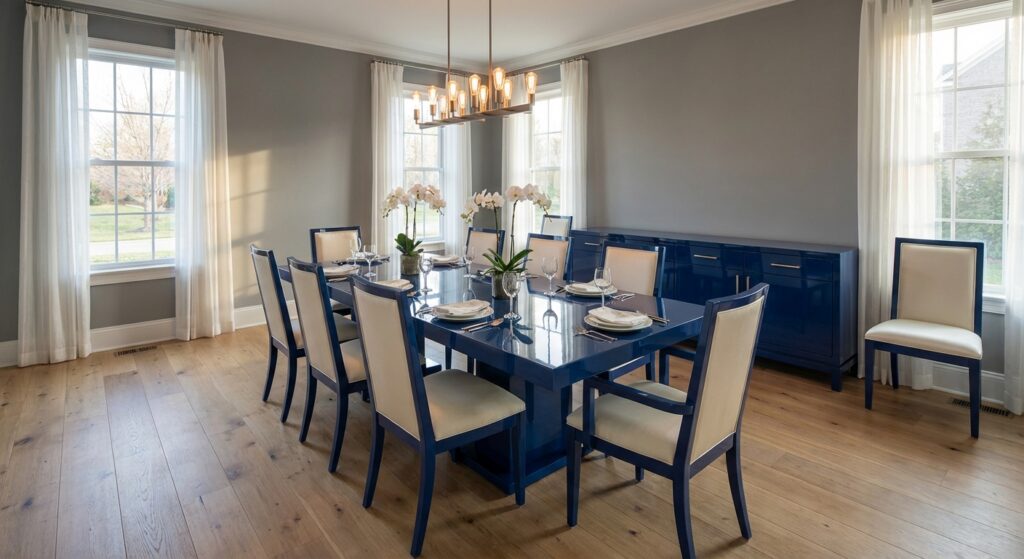
Dining table dimensions influence finish selection. Tables exceeding 96 inches require sectional application to prevent orange peel defects from extended working time. Chairs and case goods under 48 inches accommodate single-session coating.
Room Size and Finish Load Recommendations
| Dining Room Size (sq ft) | Recommended Gloss Coverage (%) | Optimal Piece Count | Metal Accent Ratio | Ambient Light Requirement (lumens) |
|---|---|---|---|---|
| 120-180 | 35-45% | 5-7 pieces | 12-15% | 2,400-3,200 |
| 180-250 | 45-55% | 7-9 pieces | 15-18% | 3,200-4,500 |
| 250-350 | 55-65% | 9-12 pieces | 18-22% | 4,500-6,000 |
| 350-500 | 60-70% | 12-16 pieces | 20-25% | 6,000-8,500 |
Maintenance Requirements and Longevity Data
High-gloss lacquer demands specific care protocols. Microfiber cloths with 0.3-0.5 denier fiber density prevent micro-scratching. Cleaning solutions must maintain a pH of 6.5-7.5; alkaline cleaners above pH 8.0 can cause hazing within 18-24 months of regular use.
Real-world durability testing conducted according to Consumer Product Safety Commission protocols shows that properly maintained high-gloss finishes retain 92-96% of their initial reflectance after 10 years, compared to 78-84% for satin finishes under identical conditions.
Maintenance Cost Analysis (10-Year Period)
- Professional re-buffing every 36 months: $280-$420 per piece
- Annual deep cleaning service: $150-$240 total
- Specialized cleaning products: $180-$260 total
- Minor repair kit (scratches, chips): $90-$140 total
- Cumulative 10-year maintenance: $1,820-$2,940 per dining set
- Comparable matte finish maintenance: $890-$1,460 per set
Economic Analysis and Market Positioning
High-gloss lacquered dining furniture commands retail prices 140-185% above equivalent wood-stain pieces. A standard six-chair dining set in piano black lacquer retails $8,400-$14,200, compared to $3,500-$6,800 for oil-finished hardwood. Consumer acceptance data from Bureau of Labor Statistics expenditure surveys indicate that households with incomes above $165,000 allocate 3.2x more of their budget to glossy finishes than households in lower income brackets.
Resale value retention favors lacquer. Five-year depreciation averages 32-38% for high-gloss pieces versus 48-56% for matte alternatives, assuming proper maintenance. Limited-production colored lacquers appreciate 8-12% annually in secondary markets.
Price Comparison by Finish and Furniture Type
| Item | High-Gloss Lacquer | Satin/Matte Finish | Natural Wood Stain | Price Differential |
|---|---|---|---|---|
| Dining Table (96″) | $4,200-$7,800 | $2,400-$4,200 | $1,800-$3,400 | +133% vs. stain |
| Dining Chair (each) | $680-$1,200 | $420-$740 | $320-$580 | +112% vs. stain |
| Buffet/Sideboard | $3,800-$6,400 | $2,200-$3,800 | $1,600-$2,900 | +137% vs. stain |
| China Cabinet | $4,600-$8,200 | $2,800-$4,800 | $2,100-$3,900 | +119% vs. stain |
Environmental and VOC Considerations
Modern waterborne lacquers contain 50-150 g/L volatile organic compounds, meeting EPA indoor air quality standards for residential applications. Traditional solvent-based systems measure 400-550 g/L, requiring extended off-gassing periods of 14-21 days, compared with 3-5 days for water-based formulations.
Production energy consumption differs substantially. UV-cured systems use 60-70% less energy than thermal-cure lacquers, requiring 18-24 seconds exposure time versus 45-90 minutes baking cycles. This translates to 0.8-1.2 kWh per square meter for UV versus 3.2-4.8 kWh for conventional baking.
VOC Content by Lacquer System
| Lacquer Type | VOC Content (g/L) | Off-Gassing Period (days) | EPA Compliant | Energy Use (kWh/m²) |
|---|---|---|---|---|
| Waterborne Polyurethane | 50-90 | 3-5 | Yes | 2.1-3.4 |
| UV-Cured Acrylic | 80-120 | 1-2 | Yes | 0.8-1.2 |
| Catalyzed Conversion | 180-250 | 7-10 | Yes (with ventilation) | 3.8-5.2 |
| Nitrocellulose (Traditional) | 450-550 | 14-21 | Requires exemption | 3.2-4.8 |
| Pre-Catalyzed Lacquer | 380-480 | 10-14 | Requires exemption | 4.1-5.9 |
Installation and Design Integration
Successful high-gloss dining rooms balance reflective surfaces with light-absorbing elements. Textiles should comprise 18-25% of room volume through upholstery, drapery, and area rugs to prevent acoustic harshness. Sound reverberation time (RT60) in fully lacquered spaces measures 1.8-2.4 seconds versus the ideal 0.8-1.2 seconds, requiring acoustic compensation.
Lighting placement requires precision. Fixtures positioned directly above glossy tables create hotspots measuring 4.5-6.2x ambient brightness. Offset positioning at 24-36 inch horizontal displacement reduces glare by 72-81% while maintaining adequate task lighting at 300-500 lux.
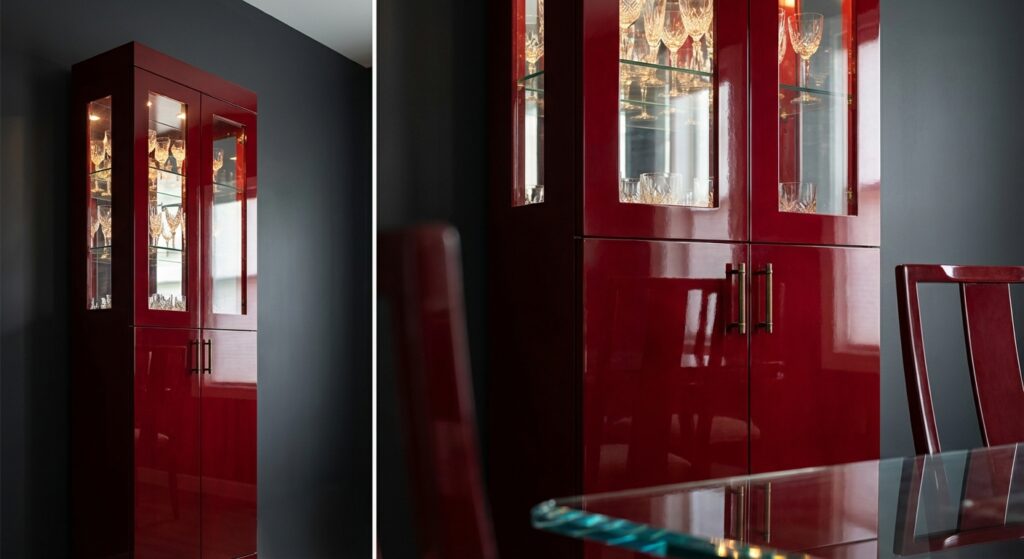
Recommended Room Element Ratios
- High-gloss surfaces: 35-45% of visible area
- Matte surfaces (walls, ceiling): 30-40%
- Textile/soft goods: 18-25%
- Metal accents: 15-20%
- Wood grain (visible): 8-12%
- Maximum gloss coverage before sensory overload: 48-52%
- Minimum for impactful presentation: 28-32%
Regional Market Adoption Patterns
Geographic preferences show distinct patterns. Northeast metropolitan areas report 64% higher adoption rates for glossy finishes than Midwest regions. California leads jewel-tone selection at 42% of colored lacquer purchases, while Southern states favor black lacquer at 67% of gloss furniture sales.
Climate influences maintenance requirements. Humidity above 65% increases water spotting incidents by 340% compared to controlled 45-55% environments. Desert climates with below 30% humidity cause micro-cracking in improperly formulated lacquers within 24-36 months.
Regional Preference and Climate Data
| Region | Gloss Adoption Rate | Preferred Color | Avg Humidity % | Maintenance Multiplier |
|---|---|---|---|---|
| Northeast Urban | 58% | Black (48%), Emerald (23%) | 55-68% | 1.3x |
| Southeast Coastal | 41% | Black (67%), Ruby (18%) | 62-78% | 1.8x |
| Midwest | 29% | Black (71%), Natural (22%) | 48-62% | 1.0x |
| Southwest Desert | 35% | Topaz (31%), Black (42%) | 18-32% | 1.4x |
| West Coast | 52% | Sapphire (28%), Black (39%) | 45-58% | 1.1x |
Technical Specifications for Professional Procurement
Specification sheets should detail film build, cure schedule, and performance standards. Commercial-grade lacquers meet KCMA A161.1 certification for kitchen and bath cabinets, applicable to dining furniture durability. This standard requires passing 10-cycle water resistance, 100-cycle detergent resistance, and impact resistance of at least 150 inch-pounds.
Substrate preparation proves critical. MDF requires 3-4 coats of high-build primer at 4-6 mils dry film thickness before lacquer application. Hardwood accepts lacquer at 2-3 primer coats. Inadequate substrate preparation accounts for 78% of premature finish failures within 36 months, according to NIST failure analysis data.
Quality Certification Standards
| Test Standard | Requirement | High-Gloss Target | Pass Rate (Premium) |
|---|---|---|---|
| ASTM D3363 (Scratch) | Minimum 2H | 4H-5H | 94% |
| ASTM D2794 (Impact) | 100 inch-lbs | 150-180 inch-lbs | 91% |
| ASTM D3359 (Adhesion) | 4B rating | 5B rating | 97% |
| ASTM D4060 (Abrasion) | Max 30mg loss/1000 cycles | 12-18mg loss/1000 cycles | 88% |
| ASTM D1308 (Chemical) | No visible effect | No effect 24hr exposure | 92% |
The return of high-gloss lacquer reflects fundamental shifts in design priorities. Surfaces that amplify light, showcase craftsmanship through depth and clarity, and provide measurable performance advantages have displaced the decade-long dominance of flat, texture-focused finishes. Market data, material science, and consumer preference align: reflective brilliance has regained its position at the premium end of residential furniture.